Thursday, October 28, 2010

What We're Reading Now

Sometimes books come along that, like a wise, sympathetic, and inspiring friend, let you know you are not alone in your beliefs, preferences, or habits.  Open the cover, read a few lines, and suddenly you’re part of a collective rather than being a loner.  Jennie Hinchcliff and Carolee Gilligan Wheeler’s book Good Mail Day: A Primer for Making Eye-Popping Postal Art has been the most recent of my “good friend” books.* 


More than a year ago, frustrated with the mass audience of facebook, I tried to renew letter-writing relationships with far flung friends and family.  It was slow going, and I began to wonder if a need to send and receive letters was just another strange quirk, like not liking the feel of wood decking on bare feet, or believing there is such a thing as “too sweet.”  However, just as I was waning in my commitment to the post, Good Mail Day appeared to cheer me on and reassure me that a small, dedicated, and sane (or at least not any weirder than anyone else) group of people still communicate through the mail.  

Good Mail Day has kept me writing to friends (new and old) and family, and it’s also inspired me to start making mail art.**  My husband says he’s noticed that I am cheerier and more focused since I decided to keep the computer screen dark at night and turn my attention to pen, paper, scissors, glue, and stamps.  So here's to the authors, my pen pals, and the USPS.   


 Envelopes/postcards (clockwise from upper left) by: Carolee W. of SF, Kevin J. of Lummi Island, Pamela G. of SF (center and lower right), Stephanie B. of NYC, and Bryan K. of Long Beach

*Other fairly recent books on the “good friend” list include The Introvert Advantage: How to Survive in an Extroverted World by Marti Olson Laney and Thomas Moore’s A Life at Work: The Joy of Discovering What You Were Born to Do.  

**Mail art is a decades-long tradition comprised of an interesting and egalitarian network of folks sending art through the mail. 

-T. Jones

Thursday, October 14, 2010

Organ Progress

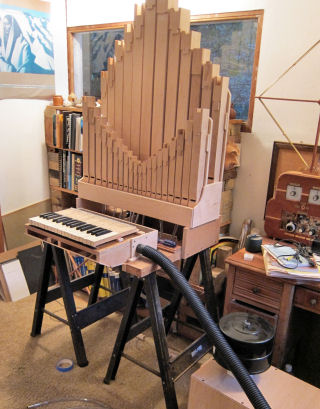
Here's the organ set up on sawhorses in my shop at home, where I construct most of my exhibits for Mindport. The cover is off the keyboard console and in the process of being varnished. On the floor, just to the right of the organ is the blower box, which includes an air pressure regulator. This keeps the pressure to the pipes more or less constant no matter how many keys are pressed. On top of the box is an air filter (the round black thing) to keep dust and debris out of the organ's valves and pipes. That black hose going into the right side of the keyboard console is the main air hose, bringing air from the blower/regulator to the "wind chest" where all the key valves reside. The smaller hoses from the valves are now all connected to the pipes, which I've temporarily tuned up. A couple valves had to be revamped because they leaked, but everything seems to work OK  now, and I've even been hacking out a few tunes with my very inadequate keyboard skills.

Next job is to install set screws on the tuning slides at the top of the pipes so they can be locked in position once they're set to the correct pitch. At the moment, the slides are held in position with tape. Installing the set screws involves drilling holes in the slides, tapping them, and screwing in set screws with locking nuts. This job that will be done concurrently with applying oil finish to the pipes, which all will take a couple days. The final task is to design and construct a table to hold The pipes and the keyboard console. Then the organ will be ready for its public debut.

Kevin Jones

Friday, October 1, 2010

The Waste Stream

In Cairo, Egypt, an under-recognized group called the Zaballeen have been responsible over the last hundred years or more for the city's garbage collection. Not only do they collect from door to door, but they recycle 80 percent of the garbage they process, recapturing materials such a plastic, fiber, and metals to be sold within their own country and exported to Europe.

The lives of this remarkable group are explored in a documentary film by Mai Iskander, called Garbage Dreams. In watching it, I marveled at the creativity and ingenuity of these people, who live under marginal conditions in a slum area of Cairo. They've set up a safe recycling school for their youngsters and even sent a couple of them to study the recycling industry in Wales, where, as it happens, only 27 per cent of the refuse collected is actually recycled. The country is striving to raise the percentage another ten per cent in the future. If so, they'll still be far behind to 80 per cent claimed by the Zaballeen, who manage it with human labor and  extremely primitive equipment.

The down side of the Zaballeen's story is the fact that they're considered to be what might be known as in India as "untouchables." They tend to be shunned and their essential contribution to society has been locally ignored. Consequently, the powers-that-be in Cairo, anxious for the city to be viewed as "world class," have contracted with foreign-based companies to collect the city's refuse. No effort is apparently made by these companies to recycle. Instead, the trash is buried in a desert landfill.

The film set me thinking about the generally low status accorded to those who deal with our trash and our sewage, despite both functions being essential to our comfortable survival. I speculate that this is due to the fact that in a consumption-based culture, we can't afford to notice either where our plenty comes from, or where it goes when we're done with it. To blindly consume without fear of guilt or consequence, we must believe that it magically appears on our store shelves, then just as quickly evaporates into thin air once we've used it up or grown tired of it.

I urge you to see this film. It's reviewed on Netflix, but not currently available there. For readers local to this area, you can find it across the street from Mindport at Film-is-Truth.


Kevin Jones

Thursday, September 9, 2010

The Invasion of the Mindsnatchers

I'm reading a book that gives voice to many of my own misgivings about computers and the Internet: The Shallows- What the Internet is Doing to our Brains, by Nicholas Carr. Back in 1964, Marshall McLuhan warned us that "The Medium is the Message," which is to say that the media we use to express ourselves carry their own strong message, of which we may not be conscious. In other words, the means by which the communication is presented affects what we're able to be aware of and how we think. Carr argues that despite the access the Internet gives us to information, it may not be making us smarter, and it likely is having a deleterious affect on our ability to think clearly or deeply, and even to read.

Periodically my own preoccupation with the subject of computers, the Internet, and their effects on us inspires yet another rant on that subject. Carr's book confirms much of what I've noticed myself in my daily wandering on the web, namely how it fosters a condition that I term "infoblitz," a consequence of the flood of information, much of it that we don't even want, that assaults us any time we visit almost any website. As such web composition tools as Javascript become more sophisticated, so do the assaults. Have you encountered those ads that pop up right in the middle of the text you're reading and then follow you down the page until you either click on them or manually close them? It's no wonder that our ability to think coherently is suffering.

I notice now that practically every commercial website I visit carries the message, "Follow us on Facebook or Twitter." My reaction is, why would I want to follow you? If I need something you sell, then I'll visit your site and buy it. I've categorically rebelled against Facebook, Twitter, and even Flickr. There was a time when I was quite active on Fotolog.com, which was (and presumably still is) a kind of photographic social networking site. Eventually it was taken over by teenagers from Brazil. At that point, I vacated to Flickr, which seemed to be the favored site of more serious photographers. But my interest has lagged. One reason for this is that the nature of the Internet medium dictates to a large degree what sort of pictures do well when posted on Flickr's pages. I find my eye being attracted to what know will be noticed, then neglecting everything else. This is how the "message of the medium" asserts itself.

Flickr is a more complex site than was Fotolog, with many more social options. Increasingly, I'm finding that I just can't be bothered to indulge in the social networking aspect of the site. there are too many options. Exercising them all can come to rule your life. I'd rather spend my time building exhibits for Mindport, reading, writing, or even watching movies. This has become my reaction to the Internet in general. My interest in "Doomer" sites, concerned with economic and societal collapse is waning, not because I don't believe we're in deep trouble, but because I question whether there's any point in being preoccupied with it. I have enough information on that subject, thank you all the same. Yes, I still glance at the headlines, but the advertising and an infinite number of other annoyances associated with computers and the web have become so overwhelming that the rewards have diminished to nearly zero.

One of the effects of the Internet medium that Carr discusses in his book is its tendency not only to truncate our reading, but to actually diminish our ability to concentrate on long passages. He cites research indicating that visits to any particular  page on the web run to less than a minute, and often only a few seconds. Data about this blog from Sitemeter bear that out. In fact, you probably haven't even read this far, so why do I even bother to carry on? Well, because I write these entries more to discover what I'm thinking, than for any other reason. If I were writing according to what the experts have determined is the best style for the Web, I wouldn't be writing at all.

Just now, a window pops up telling me that Mindport has one new message from an electronics supplier. It pops up right on top of where the cursor rests, interrupting my writing and my flow of thought . I can't get the window to close. Is it any wonder that I increasingly dream of the day when I can abandon computers altogether and live a normal life like I did twenty years ago? As it stands, I reverted to writing in my personal journal with pen on paper. For some time, I attempted my journal writing via computer, thinking how it would simplify life when I wanted to search for the date of some detail in the past. But I abandoned it, and not on principle, but because I found manual writing a more satisfactory way to keep a journal than was keyboarding. It's such a pleasure to be able to alternately mull and scribble with no message popping up telling me the battery is getting low, or that Microsoft wants to download its one-hundredth update to Windows XP, or that the word-processing program with which I'm writing wants me to upgrade to a new version that will probably require me to learn all over how to use it.

Kevin Jones

Friday, August 27, 2010

Can you hear me now?

Drop by our gallery window and view AnMorgan Curry's latest work, this time on the subject of the cell phone revolution. Have you ever noticed how cell phones perfectly resemble the ideal skipping stone?

Saturday, August 14, 2010

Photography as Meditation

What IS meditation, anyway? It's a term bandied about, applied to many areas of endeavor, but, aside from specific forms, such as Transcendental Meditation (TM) it's a term that has a way of floating around and lighting on seemingly unrelated things like a wilting helium balloon.

I've practiced a couple formally-taught types of meditation myself. Such formal practices don't pin down all the mental processes to which the term might be applied. Upon contemplating the idea, I think a good blanket way of defining meditation is simply that it's a process of mindfully paying attention. By mindful, I mean learning to consciously note where your mind is going. The Buddhists speak of "monkey mind," which refers to the way that the mind has a way of drifting off in all directions, hardly controllable at all. Some forms of meditation involve noticing when the mind has drifted off, then pulling it back to focus on one thing, which can be an internally-repeated sound (mantra), on body sensations, or on something in the visual field, such as a candle flame. 

For many years I've enjoyed the practice of photography. I refer to it here both as practice, in the sense of simply doing it, but also in the sense of meditative practice, which is doing photography while paying conscious attention to where it takes me and where I take it.

There was a time when I considered the possibility of a career as a professional photographer. From present perspective, I feel very fortunate not to have taken that path, because it's left me free to photograph whatever I want or not to photograph at all if I'm not moved to do so. It's been interesting to notice where photography has taken me over the nearly sixty years that I've been shooting photos.

Having just written that phrase "shooting photos" brings me to an area of photographic awareness that only came to consciousness for me within the last two years. Somewhere on the web I encountered an essay about photography in which the writer pointed out that we use many terms of aggression when we describe the process of recording photos. We take, shoot, capture, grab, catch, snap, or steal, photos, to name a few examples. Ads in photo magazines often picture photographers using cameras with long, phallic-looking telephoto lenses, or they represent photographic subject matter with images that emphasize the giant staring-eye quality of a camera lens.

The essay set me to thinking about my own relationship to photography. Never having been forced by professional necessity to photograph anything in particular, or to photograph at all, I realized that most of the time photos actually capture me. I'll be walking along and the subject of a photo kinda clicks into view, which sends me reaching for my camera. At times I'll actively stalk photos, but even in that case, it involves walking around with camera in hand and no specific ideas, waiting to be grabbed by something.

Part of what makes photography a meditative pursuit for me is that it encourages me to pay attention to what grabs me.

Approaching the meditative aspect of photography from another direction, I believe it's useful to discuss what I view as the most important aspects of shooting arresting images. Or maybe it would be better to say, the most important qualities of mind and vision to cultivate in order to be arrested by scenes that capture attention.

Years ago I took a couple quarters of photography courses at the University of Colorado. My teacher, Charles Roitz used to talk about photos with a quality of "otherness." It took me years before I began to understand what that meant.

In practicing meditative photography I gradually learned two important and mutually allied skills, which extend to many other areas of life beside photography. One is learning to see the whole frame at once, and the second is learning to stop naming things.

Conventionally, when we "shoot" photos, the tendency is to take a picture of something, some named object: "Here's a picture of my car, my mother, my house, the rose in the garden," etc. We frame things, i.e. pick a named thing, put a frame around it, and call it a rose. The truth is, a photo is a pattern of color, light, and dark on a piece of paper. In a picture of a rose, there's a rose, then there's all the things around the rose, including the things that are outside the frame. If you stop naming the rose, see it as a blob of color and pattern, and let it fit into all the color and pattern around it, the subject of the image may become something other and quite possibly more interesting than what you expect. You might not even be able to name it because it's a feeling quality or something completely inexpressible, except as its own expression.

Similarly, in ordinary life we often trip ourselves up by naming something, stuffing it into a box, mentally speaking, then not noticing how it fits the big picture of all the things going on around it. To give an example, which happens to be uppermost in my mind in these times of economic disaster, a tendency in our culture has been to focus on the "bottom line" to the exclusion of all else. We've generally come to judge transactions by whether or not they make a profit for someone, with no consideration as to the effect the transaction has on the people involved or anyone else in proximity. It's a destructive and limiting way of living.

Hence, I assert that photography, practiced mindfully, can teach us many important lessons about ourselves and life, perhaps one of the most important being to become more sensitive to where our own feelings and interests carry us, rather than allowing ourselves to be seduced by ideas of what may currently be "cool" or acceptable.

Suggested reading: The Tao of Photography: Seeing Beyond Seeing  by Philippe L. Gross and S.I. Shapiro
For more photos see my Flickr site

Kevin Jones

Wednesday, August 4, 2010

Information Overload

There's a useful editorial by Mark Morford on the SFGate website this morning, discussing a subject I've thought a great deal about lately, namely information overload. Morford comes at the subject from a particular direction, upon which he pins the acronym "FOMO," or Fear of Missing Out. By coincidence, John Michael Greer, on his Archdruid Report  website (July 28, 2010 entry) touched on the same subject with a discussion about what information IS. He quotes Gregory Bateson thus: information is "a difference that makes a difference."

In contemplating the subject of information myself, I came up with the following definition: "Information is guidance." The hidden implication of that definition is that floods of information are useless unless they inform something, i.e. you gotta have an idea about where you're going in order for information to be of any use to you. If you're prone to randomly surfing the web, eyes glazed, sliding down breaking waves of raw data, chances are you'll find something that catches your eye here and there, and you'll while away hours tripping through a maze of links leading to who-knows-where. Before you know it, it's dinnertime, you're exhausted by the flood, and, after dinner can hardly muster the energy to watch a movie, much less to spend a couple hours reading a book.

Twitter and Facebook are probably the worst tweakers of Morford's FOMO syndrome. Has anyone organized Facebooker's Anonymous yet? From all I read, it seems like a ripe time for it. Nearly every business site I visit sports a logo somewhere: "Follow us on Facebook." "Follow us on Twitter." Thanks, but why should I want to? What will I be missing if I don't bother?

For a short time Mindport appeared on Facebook. We shut down our Facebook page after a few weeks because nobody wanted to keep thinking up trivial new nothings to post on it. As it stands, our blog postings demand a couple hours of thought and energy from one of us every week or two. I figure, if you're going to post something, it might as well be something that you put enough energy into to make it worth your reader's time.

Once I'd defined information as guidance, it clarified my relationship to the Web and alleviated the problem of information overload. You can surf the web out of boredom, looking for diversion. It can provide that for hours at a time, but what are you left with when you're done? Mostly fatigue. On the other hand, if you go at it with the idea in mind that information is guidance, then ask yourself the obvious question is, "guidance for what?" Or if you ask, "where do I want to be guided?" it lends focus to one's relationship with the Internet.  In other words, in order not to become a victim of info-blitz, it's helpful to approach the Web with filters in place, with intention in mind. For me, the process of determining a direction is best accomplished off-line, by paying mindful attention to my own internal workings. That leads to approaching the web in a similar spirit, with a focus on my own center rather than indulging in a diffuse tumble, eyes glazed, over undifferentiated waves of data.

Kevin Jones


Site Meter