Tuesday, December 7, 2010

Looking Up


Winter in the Northwest is traditionally a time of clouds. Like bird watchers in the summer, we cloud watchers find our heyday during the season of storms and atmospheric ferment. In these days of economic disaster what better strategy for forgetting earthbound cares than to gaze toward the skies?


When I was in my Junior year of college, I was still undecided what I wanted to study. For a bit, I considered meteorology. After all, it's a field in which my father had been trained, and growing up under his tutelage I was kept informed of the collision of the fronts, the moist breath of the fog, the tower of the cumulus and the feathery loft of the cirrus. Nowadays my wife and I joke about the "upper level low-lying stratus deck." I never pursued meteorology academically, as it turned out.  I quickly discovered it was all math, a subject for which I'd never been enthusiastic. Math, after all, is only an artificial, secondary expression of the poetic forms expressed by the clouds. That's where the magic is for me.


So I became a cloud watcher and a cloud photographer. I know a little about the physics of weather and, from that perspective, why some clouds look the way they do. But I also believe cloud forms relate directly to emotion, that the flow and turbulence of the atmosphere parallel the flow and turbulence of water and furthermore, to patterns of mental process within our own psyche. After all, we are, in large part, fluid. Our physical motion is constrained by the same forces that move and constrain the atmospheric gasses and the motions of flowing water.  In the clouds we see dance. The experience of motion, modified by the forces of momentum, inertia and gravity lay the grounding structure in our consciousness for the later arrival of verbal language and thought. Consider also that from the earliest days of human existence, our survival must often have depended on an evolved intuitive ability to read the message written in the clouds.


In our culture, we speak derogatorily of someone whose "head is in the clouds." But angels sit on clouds, so why would we think less of someone whose head occupies the domain of the angels?

Kevin Jones

Thursday, November 11, 2010

"A Book About Noise"

I've just finished another book dealing with one of my pet gripes, noise: The Unwanted Sound of Everything We Want: A Book About Noise, by Garret Keiser.  It approaches the subject from a perspective that has barely been touched upon by other books dealing with it, namely its social and economic implications. To me, Keiser's most important point is that there's a direct relationship between the amount of noise we encounter and economic inequality. He asserts that an egalitarian culture is a quiet culture, and vice-versa, an idea that I find intriguing because it leads my thinking on the subject of noise into a whole new realm.

Keiser points out a paradox, namely that anyone who objects to noise is often characterized as a crank, yet there's a premium associated with living in a quiet place. Which is to say, property values decline in the vicinity of airports, race car tracks, and freeways. Read the classified real estate ads and notice how often a home's  location in a "quiet neighborhood" is included as an important selling point. The implication of this paradox is that those who are most subject to noise are the most powerless. If you're poor, good luck at getting anyone to respond to your complaints about excess noise.

The word "noise" is itself open to interpretation. As Keiser notes, the general definition of noise is the sounds you don't want to hear. On Lummi Island, where I live, the sound of breezes stirring the leaves on a summer day is a sweet sound. On the other hand, the constant dull roar of a winter nor'easter becomes a maddening noise in quick order.  Being a water lover and a boat person, the sound of loud boats bothers me less than the continuous passage of propeller-driven aircraft overhead. The airplanes are an irritation, whereas the boats stir my nostalgia. They usually are not nearly as loud as the aircraft, either.

Keiser devotes a chapter to the subject of a Harley rally that he attended in the town of Sturgis, South Dakota. He said one thing that surprised him was the high level of politeness he observed amongst the riders present. One of them saw him standing by the street edge, actually stopped, and yelled over the roar of his vehicle, "Would you like to cross the street."

The beauty of the beast
Later in the book Keiser defines "silliness" as knowing perfectly well that something you're doing is wrong, or doesn't make sense, but you do it anyway. He uses the noise of the aforementioned motorcycle rally as an example. As I interpret his view, politeness of the crowd there can be understood as a compensatory act to distract from behavior that in most circles is unacceptable . Which is to say, you offend everyone within 100 yards with your racket, then act super polite. . . or raise money for charitable causes, as Harley clubs have been known to do, in order to defuse anyone's annoyance at your obvious transgression of normal standards of social consideration.

An example of this "silliness" from my own life similarly concerns the intrusive racket of loud motorcycles roaring up the hill next to my house. One day I observed a neighbor of mine mounting his "rig," and plugging earplugs into his ears before donning his cycle helmet. (This is an otherwise considerate, pleasant and public-spirited guy) I wanted to ask him, but didn't, "If you need ear plugs to handle the roar of the vehicle you're riding, why would you think your neighbors would enjoy it as you pass by? He knows that noise is annoying, can damage his hearing, or raise his (and your) blood pressure, and he knows it well enough to bother protecting himself, yet does not offer the same consideration to his neighbors. This, if I understand Keiser's view correctly, is "silliness," paralleling accusations mothers make of their kids when they do thoughtless things.

In case I've offended any motorcycle buffs, let me add that my driver's license carries a motorcycle endorsement, and I have nothing whatever against motorcycles in general or Harleys in particular, other than when their racket intrudes on my property and peace.

Absorbing Keiser's book took concentration on my part because he arrives at his conclusions by sometimes circuitous reasoning interjected at unexpected times with humorous asides. These would catch me off guard so that I needed to stop and think about whether that was a subtle dig or a straight statement. He's someone who obviously hates noise but is attempting to be fair and objective about it. (Personally, I don't even want to be fair, I want them to shut up!) But, it's a rewarding read, especially if you're a noise "crank." It opened my mind to aspects of the subject that heretofore have only lurked on the wings of my musings. If noise is an issue in your life, or you'd just enjoy a new perspective on it, give this book a try.

Kevin Jones

Friday, November 5, 2010

The Island Quilters

The latest work of The Island Quilters opens tonight in Mindport's gallery and runs until December 31th. These three women from Lummi Island have been meeting together to share ideas and humor since 2004. Their last show in Mindport's gallery, in 2006, was great success and we're most happy to have our space graced once again by the cheering colors of their newest efforts.

Thursday, October 28, 2010

What We're Reading Now

Sometimes books come along that, like a wise, sympathetic, and inspiring friend, let you know you are not alone in your beliefs, preferences, or habits.  Open the cover, read a few lines, and suddenly you’re part of a collective rather than being a loner.  Jennie Hinchcliff and Carolee Gilligan Wheeler’s book Good Mail Day: A Primer for Making Eye-Popping Postal Art has been the most recent of my “good friend” books.* 


More than a year ago, frustrated with the mass audience of facebook, I tried to renew letter-writing relationships with far flung friends and family.  It was slow going, and I began to wonder if a need to send and receive letters was just another strange quirk, like not liking the feel of wood decking on bare feet, or believing there is such a thing as “too sweet.”  However, just as I was waning in my commitment to the post, Good Mail Day appeared to cheer me on and reassure me that a small, dedicated, and sane (or at least not any weirder than anyone else) group of people still communicate through the mail.  

Good Mail Day has kept me writing to friends (new and old) and family, and it’s also inspired me to start making mail art.**  My husband says he’s noticed that I am cheerier and more focused since I decided to keep the computer screen dark at night and turn my attention to pen, paper, scissors, glue, and stamps.  So here's to the authors, my pen pals, and the USPS.   


 Envelopes/postcards (clockwise from upper left) by: Carolee W. of SF, Kevin J. of Lummi Island, Pamela G. of SF (center and lower right), Stephanie B. of NYC, and Bryan K. of Long Beach

*Other fairly recent books on the “good friend” list include The Introvert Advantage: How to Survive in an Extroverted World by Marti Olson Laney and Thomas Moore’s A Life at Work: The Joy of Discovering What You Were Born to Do.  

**Mail art is a decades-long tradition comprised of an interesting and egalitarian network of folks sending art through the mail. 

-T. Jones

Thursday, October 14, 2010

Organ Progress

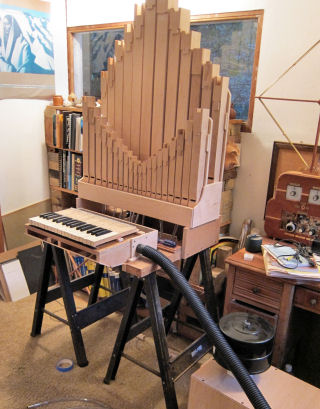
Here's the organ set up on sawhorses in my shop at home, where I construct most of my exhibits for Mindport. The cover is off the keyboard console and in the process of being varnished. On the floor, just to the right of the organ is the blower box, which includes an air pressure regulator. This keeps the pressure to the pipes more or less constant no matter how many keys are pressed. On top of the box is an air filter (the round black thing) to keep dust and debris out of the organ's valves and pipes. That black hose going into the right side of the keyboard console is the main air hose, bringing air from the blower/regulator to the "wind chest" where all the key valves reside. The smaller hoses from the valves are now all connected to the pipes, which I've temporarily tuned up. A couple valves had to be revamped because they leaked, but everything seems to work OK  now, and I've even been hacking out a few tunes with my very inadequate keyboard skills.

Next job is to install set screws on the tuning slides at the top of the pipes so they can be locked in position once they're set to the correct pitch. At the moment, the slides are held in position with tape. Installing the set screws involves drilling holes in the slides, tapping them, and screwing in set screws with locking nuts. This job that will be done concurrently with applying oil finish to the pipes, which all will take a couple days. The final task is to design and construct a table to hold The pipes and the keyboard console. Then the organ will be ready for its public debut.

Kevin Jones

Friday, October 1, 2010

The Waste Stream

In Cairo, Egypt, an under-recognized group called the Zaballeen have been responsible over the last hundred years or more for the city's garbage collection. Not only do they collect from door to door, but they recycle 80 percent of the garbage they process, recapturing materials such a plastic, fiber, and metals to be sold within their own country and exported to Europe.

The lives of this remarkable group are explored in a documentary film by Mai Iskander, called Garbage Dreams. In watching it, I marveled at the creativity and ingenuity of these people, who live under marginal conditions in a slum area of Cairo. They've set up a safe recycling school for their youngsters and even sent a couple of them to study the recycling industry in Wales, where, as it happens, only 27 per cent of the refuse collected is actually recycled. The country is striving to raise the percentage another ten per cent in the future. If so, they'll still be far behind to 80 per cent claimed by the Zaballeen, who manage it with human labor and  extremely primitive equipment.

The down side of the Zaballeen's story is the fact that they're considered to be what might be known as in India as "untouchables." They tend to be shunned and their essential contribution to society has been locally ignored. Consequently, the powers-that-be in Cairo, anxious for the city to be viewed as "world class," have contracted with foreign-based companies to collect the city's refuse. No effort is apparently made by these companies to recycle. Instead, the trash is buried in a desert landfill.

The film set me thinking about the generally low status accorded to those who deal with our trash and our sewage, despite both functions being essential to our comfortable survival. I speculate that this is due to the fact that in a consumption-based culture, we can't afford to notice either where our plenty comes from, or where it goes when we're done with it. To blindly consume without fear of guilt or consequence, we must believe that it magically appears on our store shelves, then just as quickly evaporates into thin air once we've used it up or grown tired of it.

I urge you to see this film. It's reviewed on Netflix, but not currently available there. For readers local to this area, you can find it across the street from Mindport at Film-is-Truth.


Kevin Jones

Thursday, September 9, 2010

The Invasion of the Mindsnatchers

I'm reading a book that gives voice to many of my own misgivings about computers and the Internet: The Shallows- What the Internet is Doing to our Brains, by Nicholas Carr. Back in 1964, Marshall McLuhan warned us that "The Medium is the Message," which is to say that the media we use to express ourselves carry their own strong message, of which we may not be conscious. In other words, the means by which the communication is presented affects what we're able to be aware of and how we think. Carr argues that despite the access the Internet gives us to information, it may not be making us smarter, and it likely is having a deleterious affect on our ability to think clearly or deeply, and even to read.

Periodically my own preoccupation with the subject of computers, the Internet, and their effects on us inspires yet another rant on that subject. Carr's book confirms much of what I've noticed myself in my daily wandering on the web, namely how it fosters a condition that I term "infoblitz," a consequence of the flood of information, much of it that we don't even want, that assaults us any time we visit almost any website. As such web composition tools as Javascript become more sophisticated, so do the assaults. Have you encountered those ads that pop up right in the middle of the text you're reading and then follow you down the page until you either click on them or manually close them? It's no wonder that our ability to think coherently is suffering.

I notice now that practically every commercial website I visit carries the message, "Follow us on Facebook or Twitter." My reaction is, why would I want to follow you? If I need something you sell, then I'll visit your site and buy it. I've categorically rebelled against Facebook, Twitter, and even Flickr. There was a time when I was quite active on Fotolog.com, which was (and presumably still is) a kind of photographic social networking site. Eventually it was taken over by teenagers from Brazil. At that point, I vacated to Flickr, which seemed to be the favored site of more serious photographers. But my interest has lagged. One reason for this is that the nature of the Internet medium dictates to a large degree what sort of pictures do well when posted on Flickr's pages. I find my eye being attracted to what know will be noticed, then neglecting everything else. This is how the "message of the medium" asserts itself.

Flickr is a more complex site than was Fotolog, with many more social options. Increasingly, I'm finding that I just can't be bothered to indulge in the social networking aspect of the site. there are too many options. Exercising them all can come to rule your life. I'd rather spend my time building exhibits for Mindport, reading, writing, or even watching movies. This has become my reaction to the Internet in general. My interest in "Doomer" sites, concerned with economic and societal collapse is waning, not because I don't believe we're in deep trouble, but because I question whether there's any point in being preoccupied with it. I have enough information on that subject, thank you all the same. Yes, I still glance at the headlines, but the advertising and an infinite number of other annoyances associated with computers and the web have become so overwhelming that the rewards have diminished to nearly zero.

One of the effects of the Internet medium that Carr discusses in his book is its tendency not only to truncate our reading, but to actually diminish our ability to concentrate on long passages. He cites research indicating that visits to any particular  page on the web run to less than a minute, and often only a few seconds. Data about this blog from Sitemeter bear that out. In fact, you probably haven't even read this far, so why do I even bother to carry on? Well, because I write these entries more to discover what I'm thinking, than for any other reason. If I were writing according to what the experts have determined is the best style for the Web, I wouldn't be writing at all.

Just now, a window pops up telling me that Mindport has one new message from an electronics supplier. It pops up right on top of where the cursor rests, interrupting my writing and my flow of thought . I can't get the window to close. Is it any wonder that I increasingly dream of the day when I can abandon computers altogether and live a normal life like I did twenty years ago? As it stands, I reverted to writing in my personal journal with pen on paper. For some time, I attempted my journal writing via computer, thinking how it would simplify life when I wanted to search for the date of some detail in the past. But I abandoned it, and not on principle, but because I found manual writing a more satisfactory way to keep a journal than was keyboarding. It's such a pleasure to be able to alternately mull and scribble with no message popping up telling me the battery is getting low, or that Microsoft wants to download its one-hundredth update to Windows XP, or that the word-processing program with which I'm writing wants me to upgrade to a new version that will probably require me to learn all over how to use it.

Kevin Jones
 
Site Meter